
Agentic RAG Workflows: Building Tool-Using Agents
Retrieval-augmented generation (RAG) has become a cornerstone of modern AI systems, enabling language models to access external knowledge bases and provide more accurate, contextual responses. However, static RAG systems have limitations when dealing with complex queries that require multiple steps or tool interactions.
The Problem with Static RAG
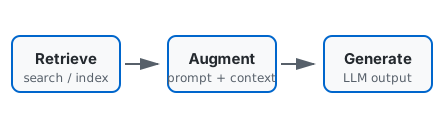
Traditional RAG systems follow a simple pattern: retrieve relevant documents, augment the prompt, and generate a response. This approach works well for straightforward queries but struggles with:
- Multi-step reasoning tasks
- Queries requiring tool interactions
- Dynamic document selection based on intermediate results
- Complex information synthesis across multiple sources
A typical static RAG flow is easy to sketch as a linear pipeline:
Shorter positional form (same order: src, alt, caption):
You can also use plain markdown — paths are relative to the site static/ folder (file static/images/photo.jpg → /images/photo.jpg):
Introducing Agentic RAG
A simple retrieval score is often written inline as \( s(q, d) = \langle \mathbf{e}_q, \mathbf{e}_d \rangle \), while a block layout can show a softmax over passages:
\[ P(d \mid q) = \frac{\exp\bigl(\alpha\, s(q, d)\bigr)}{\sum_{d' \in \mathcal{D}} \exp\bigl(\alpha\, s(q, d')\bigr)} \]You can use $$ ... $$ as well:
Agentic RAG systems address these limitations by combining the power of language models with autonomous decision-making capabilities. Instead of a fixed retrieval-generation pipeline, agentic systems can:
- Decide when and what to retrieve
- Use multiple tools in sequence
- Adapt their strategy based on intermediate results
- Handle complex, multi-turn reasoning
Implementation Considerations
Building production-grade agentic RAG systems requires careful attention to:
- Latency: Minimize round-trips and optimize retrieval operations
- Cost: Manage API calls and token usage efficiently
- Reliability: Implement fallback strategies and error handling
- Observability: Track agent decisions and reasoning paths
Example: retrieval-then-answer loop
A minimal pattern is: embed the query, fetch chunks, pack them into the prompt, then call the model. In practice you add tools, retries, and tracing around this core.
| |
You can gate retrieval with a cheap classifier, cache embeddings for hot queries, or expose retrieve as a tool so an agent decides when to call it:
| |
For local iteration, a one-liner smoke test is often enough:
| |
The future of AI systems lies in combining the reasoning capabilities of language models with the flexibility of agentic architectures and the accuracy of retrieval-augmented generation.